


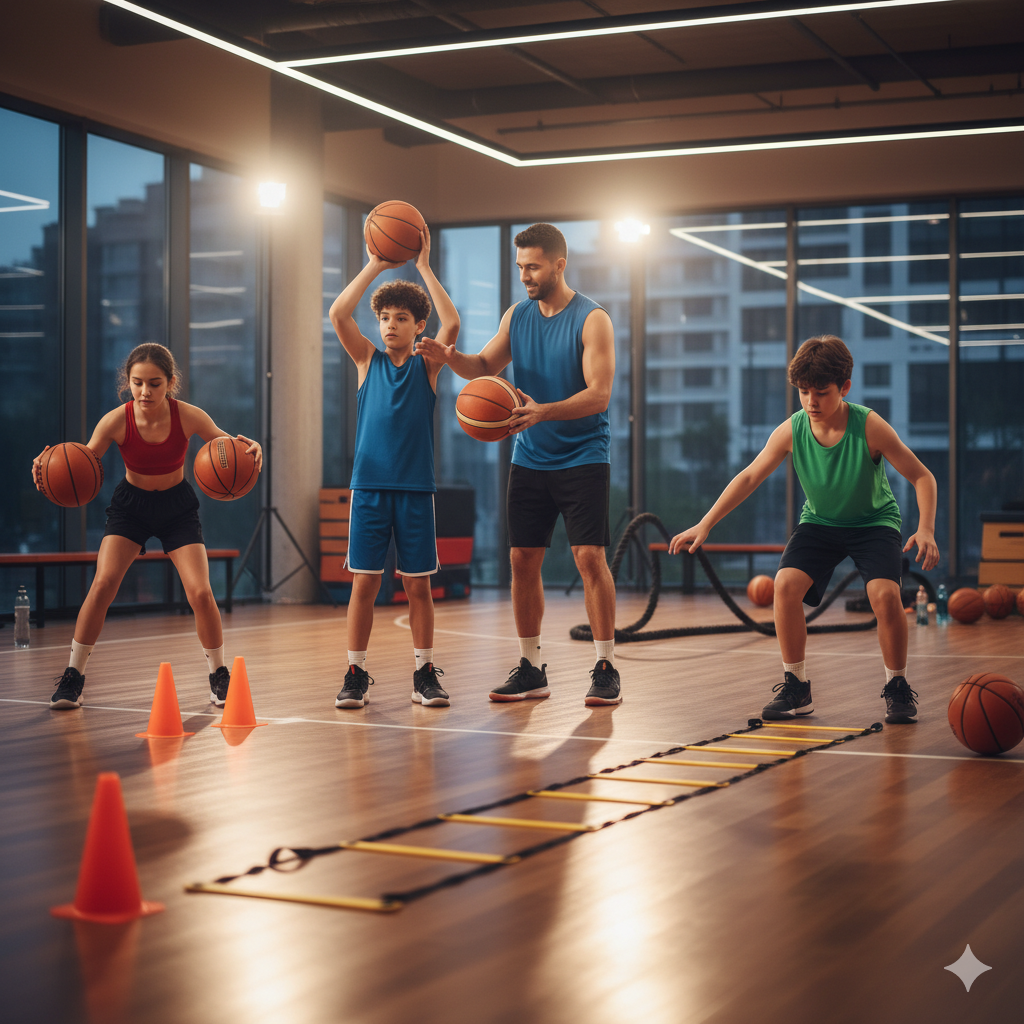
Basketball performance improves through structure, consistency, and correct instruction. Players who train without a plan often develop gaps in skill, decision-making, and confidence. Structured training removes this guesswork through structured training, based on game fundamentals, basketball IQ, and physical readiness.
At B-Ball Results, training is designed to produce measurable improvements that show during games. Each session has a purpose, and every drill supports a specific skill or game situation.
Fundamentals as the Foundation
Fundamental skills are required at every level of basketball. Ball handling, footwork, shooting mechanics, passing, spacing, and defensive positioning form the base of all player development. Lack of fundamental skills will make players unable to play uniformly under pressure.
These skills are taught properly and reinforced on a regular basis through structured training. Players are taught correct movement patterns, balance, and technique. This reduces mistakes and increases efficiency during live play.
Even experienced players benefit from continued work on fundamentals. As competitiveness becomes quicker and more physical, small technical errors lead to turnovers, missed shots, and defensive failures. Strong fundamentals help the players to be in control during high-pressure moments.
Purposeful Repetition
Repetition is necessary for skill development, but it must be intentional. Structured training emphasizes quality repetitions rather than volume alone. Drills are designed to reinforce correct technique and decision-making.
Consistent repetition helps players:
- Develop muscle memory
- Execute skills under fatigue
- Reduce hesitation during games
- Maintain form under pressure
Improvement is not rushed. Players are expected to master each skill before progressing. This approach leads to stable development rather than short-term gains.
Developing Basketball IQ
Basketball IQ is the skill of a player to read the game and make good decisions. This involves knowledge of spacing, defensive coverage, and the appropriate response to action in a particular situation.
Decision-making is added to the drills in structured training. Players are trained to respond to game-like situations rather than learning moves. This improves awareness and timing.
Training that emphasizes basketball IQ helps players:
- Make quicker decisions
- Limit turnovers
- Improve off-ball movement
- Communicate more effectively on defense.
Basketball IQ improves through repetition of real situations, not isolated drills alone.
Confidence Built Through Preparation
Confidence on the court is the result of preparation. Those players who train in an organized manner are more dependable on the field. They have faith in their mechanics, decision-making, and conditioning.
Organized training trains athletes on how to execute skills when they are under pressure. The players are presented with regulated difficulties that resemble the intensity of the game. This eliminates panic and hesitation in competition.
Confidence is developed by:
- Practicing correct technique
- Receiving clear feedback
- Understanding individual roles
- Knowing what is expected during play
This type of confidence is consistent because it is based on preparation and not just emotion.
Training Players at Different Stages
At B Ball Results, training is structured based on a player’s ability level to ensure consistency across all levels of development.
- Beginners are trained on the fundamentals of movement, ball handling, and shooting. Focus is on coordination, balance, and understanding of court spacing, with a practice pace that allows proper learning.
- Youth players reinforce fundamentals and develop positive habits. Training includes teamwork, communication, and basic decision-making, with an emphasis on long-term skill development.
- Intermediate players work on perfecting techniques and refining skills. Training focuses on tighter ball control, more reliable shooting, and improved footwork.
- High school competitors train at a higher intensity and detail. Sessions emphasize advanced skills, conditioning, situational awareness, and mental discipline, including preparation for tryouts and competitive play.
Each stage builds on the previous one to ensure steady progression.
Accountability and Feedback
Organized training is based on responsibility. Players are expected to obey instructions, remain attentive, and use feedback from trainers to improve their game. Coaches will provide athletes with direct correction so that players can understand both their strengths and areas for improvement.
Feedback helps players with:
- Identify weaknesses early
- Correct errors before they become habits
- Track improvements over time
- Remain disciplined in training
This accountability supports long-term consistency and improvement.
Game Transfer
The primary objective of training is performance on the field. Skills learned must translate into live conditions. Organized training is centered on timing, movement, and decision-making that reflect real game play.
Players trained in a structured system are better equipped to:
- Play confidently under pressure
- Adjust to different opponents
- Stay calm when anyone makes mistakes.
- Make consistent contributions in competition.
Players receiving structured training are technically sound, mentally prepared, and reliable on the game court.
Final Thoughts
Structured training creates measurable improvement. When the players continuously train on fundamentals, decision-making, and game-specific skills in a well-defined system, the improvement becomes consistent and predictable.
At B Ball Results, training is aimed at long-term player growth at each level. Regardless of whether an athlete is in basic training or training to play competitively, systematic training sessions will aid in preparing the skills in a way that they will apply easily in real game contexts.
Call our team to get more details on our training programs or to learn how to get a session!